Jagannath Rath Yatra – The Grand Chariot Festival of Lord Jagannath in Puri Jagannath Rath Yatra is an annual event that sees hundreds of thousands of Hindus flock to the city of Puri for a chance to earn religious favour…
Jagannath Rath Yatra – The Grand Chariot Festival of Lord Jagannath in Puri
Jagannath Rath Yatra is an annual event that sees hundreds of thousands of Hindus flock to the city of Puri for a chance to earn religious favour from Lord Jagganath, an avatar of Lord Krishna. It is also the one time each year that Hindus and non-Hindus can sight three religious idols that are otherwise concealed within their respective temples, so it attracts hordes of visitors from around India and worldwide.
Rituals follow the traditional sequence over several days—starting with Snana Purnima (12 June), then Anavasara, Gundicha Marjana, the main Yatra, Hera Panchami, Bahuda Yatra, concluding with Suna Besha and Niladri Bijay on 5 July
This year, rituals begin on 12th June with Snana Purnima – the bathing of the deities. Jagannath Rath Yatra itself takes place on Friday 27th June, 2025
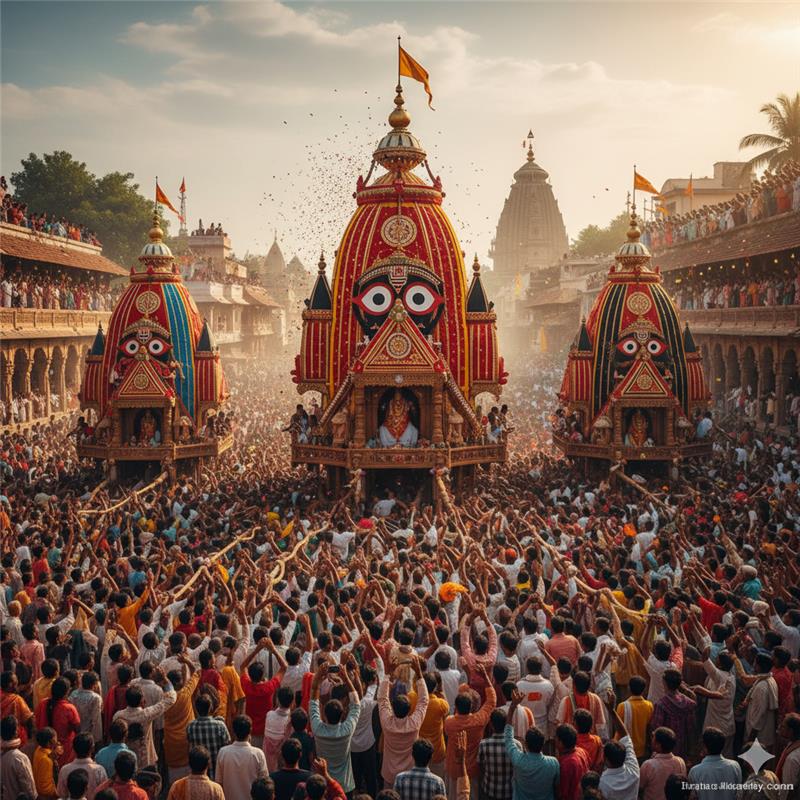
Legend has it that Lord Jagganath made annual visits to Gundicha Temple, with his brother and sister: Devi Subhadra and Lord Balabhadra. Rath Yatra commemorates this annual tradition with a grand ten day festival, which includes celebrations, darshan, music, dancing, chanting and drumming, as well as a momentous chariot-pulling event through the streets from Puri to Gundicha Devi Temple
The King of Orissa, traditionally the only person with authority to remove the idols from their temples, opens the festivities by strewing the chariots with petals. He also sweeps the ground in front of the chariots with a gold broom and sprinkles it with sandalwood water to purify and bless it. In the meantime, the fervour of devotees rises with the beating of drums, chanting and dancing. Music and dancing accompany the procession the whole way.
Idols of Lord Jagganath, the Goddess Subhadra and Lord Balabhadra are pulled in separate wooden chariots embellished by local artisans to resemble South Indian temples. Lord Balabhadra’s comes first. This stands just below 14 metres high and has 14 wheels. In the middle of the parade is Goddess Subhadra’s chariot, which is 14 metres high and has 12 wheels. At the rear, Lord Jagganath’s chariot is the largest and most vibrant. This has 16 huge wheels and measures over 14 metres high. Each chariot is tied to 50 metre long ropes, which devotees jostle to pull, as a way of showing their piety.
The whole event is imbibed with a feeling of brotherhood, with believers of all faiths coming together to witness this epic event alongside each other.
Jagannath Rath Yatra festival takes place on the second day of the new moon in the Hindu calendar month of Ashada. The main Rath Yatra 2025 festivities are on 27th June. Niladri Bijay, the chariot pulling event which sees deities transported across the city with much fanfare, takes places on 5th July. Although the chariots’ route is only 3 kilometres, due to the throngs of people lining the streets, it can take around 2 hours for them to reach Gundicha Devi Temple. After resting for 9 days in the temple, the deities are pulled back to Puri via Mausi Maa Temple, their aunt’s temple, where they are served with sweet pancakes.
What’s new at Rath Yatra?
This year, there are increased security measures to keep all visitors extra safe. The Government of Odisha has also introduced an inter-state bus: the Jagannath Express, to transport visitors from nearby cities such as Hyderabad and Tirupati, to the heart of Rath Yatra celebrations. Lifting this age-old festival into the 21st century, the new Shree Jagannatha Dham mobile app offers real-time information about queue times, navigation, the progress of rituals and more.
During the Rath Yatra festival, hotels near Puri Jagannath temple are very full and can be disturbed by the raucous celebrations. Other hotels near Puri might be a better option. Bhubaneswar to Puri by road takes just under 2 hours. By train, it takes around 1 hour. Administration is making thorough preparations to accommodate visitors coming to Bhubaneswar for the Puri Rath Yatra .
Trident, Bhubaneswar is one of the top hotels near Bhubaneswar railway station. With warm hospitality, comfortable accommodation and beautiful grounds that cover almost 57 thousand square metres of lush gardens with fruit trees, flowerbeds and manicured lawns, Trident, Bhubaneswar the perfect escape from the hustle bustle of Rath Yatra .
Dining options include a restaurant with lavish décor, resonant of the temple region the hotel is located in. The menu includes vegetarian, non-veg and seafood dishes with Indian and international flavours. There is a 24 hour fitness centre, a swimming pool, a tennis court and a jogging track, for resident guests’ exclusive use. Trident, Bhubaneswar is also equipped with electric vehicle charging stations for the convenience of guests making the Puri to Bhubaneswar trip by car.
Jagannath Temple, Puri
The Jagannath Temple is a Hindu temple dedicated to the god Jagannath, a form of Vishnu in Hinduism. It is located in Puri in the state of Odisha, situated on the eastern coast of India. As per temple records, King Indradyumna of Avanti built the main temple of Jagannath at Puri. The present temple was rebuilt from the eleventh century onwards, on the site of the pre-existing temples in the compound, but not the main Jagannath temple, and begun by Anantavarman Chodaganga, the first king of the Eastern Ganga dynasty. Many of the temple rituals are based on Oddiyana Tantras which are the refined versions of Mahayana Tantras as well as Shabari Tantras which are evolved from Tantric Buddhism and tribal beliefs respectively. The local legends link the idols with aboriginal tribes and the daitapatis (servitors) claim to be descendants of the aboriginals.The temple is one of the 108 Abhimana Kshethram of the Vaishnavite tradition.
The temple is famous for its annual Ratha Yatra, or chariot festival to honour the three gods, in which the three principal deities are pulled on huge and elaborately decorated raths, or temple cars. The worship is performed by the Bhil Sabar tribal priests, as well as priests of other communities in the temple. Unlike the stone and metal icons found in most Hindu temples, the image of Jagannath is made of spruce wood, and is ceremoniously replaced every 12 or 19 years by an exact replica. The temple is one of the Char Dham pilgrimage sites. It is also famous because many legends believe that Krishna’s heart was placed here, and the material that it is made from damages the heart, so they have to change it every seven years.
The temple is sacred and holy to all Hindus, and especially in those of the Vaishnava traditions. Many great Vaishnava saints, such as Ramanujacharya, Madhvacharya, Nimbarkacharya, Vallabhacharya and Ramananda were closely associated with the temple.Ramanuja established the Emar Matha in the south-eastern corner of the temple, and Adi Shankaracharya established the Govardhan Math, which is the seat of one of the four Shankaracharyas. It is also of particular significance to the followers of Gaudiya Vaishnavism, whose founder, Chaitanya Mahaprabhu, was attracted to the deity, Jagannath, and lived in Puri for many years
History of the Legendary Lord Shri Jagannath
Lord Jagannath, is also popularly known as Mahaprabhu. The word Jagannath is derived from confluence of two Sanskrit words, Jagat meaning “universe” and nātha meaning “Master” or “Lord”. Thus, Jagannath means “lord of the universe”. The trio of deities consisting of Lord Jagannath, Balabhadra and Subhadra are worshipped at the temple.
Lord Jagannath, Lord Baladev and Maa Subhadra are worshipped on the Ratnavedi along with Sudarshan chakra. The four deities are carved out of dark coloured Neem wood, which is considered auspicious for all castes. This also signifies that Jagannath is beyond space and time and , symbol of universal love and brotherhood. This depicts the uniqueness of Shri Jagannath deity unlike other deities in Hindu temples, which are carved out of stone and precious metals. The deities are adorned with different clothing and jewels according to the season.
The well-known descriptions , as found in the Skanda-Purana, Brahma Purana and other Puranas and later Odia Puranas state that Lord Jagannath was formerly worshipped as Shri Neela Madhaba by a Savar king , the tribal chief , named Viswavasu.
King Indradyumma was ruling over the Malava Country in Satya Yuga , the age of Truth. He was a great devotee of Lord Vishnu. After knowing about the Lord, King Indradyumna directed a Brahmin priest, Vidyapati to discover the deity, who was worshipped secretly in a dense forest by Viswavasu. Vidyapati tried his paramount resources to locate the place, but he failed in the beginning . However, at the end, he managed to convince Viswavasu’s daughter Lalita to marry him. Following the marriage , due to repetitive requests of Vidyapti, Viswavasu took his son-in-law blind folded to a cave where Lord Neela Madhaba was worshipped. Vidyapati was intelligent , in order to identify the path, he dropped mustard seeds on the ground , while he was travelling along Vidyapti . The mustard seeds sprouted into plants in a few days, which identified the way to the cave later on. On hearing the good news from him, King Indradyumna proceeded instantly to Odra desha , now known as Odisha , on a pilgrimage to visit the Lord. But on arrival he found the deity was missing. The king felt dejected but was adamant not to return without having a darshan of the Lord . He decided to perform fast unto death at Mount Neela, then a celestial voice cried ‘Thou shalt see him.’
Subsequently, the king performed one thousand Ashwamedha Yajna (sacrifice) and built a magnificent temple for Vishnu. The first Murti of Lord Narasimha was brought by Narada which got installed in the temple. Subsequently, during sleep, the king got an image in his dream of Lord Jagannath, Balabhadra, Subhadra and Chakra Sudarshan. A cosmological voice also directed him to bring the massive dark coloured, Divine Log of wood floating in the seashore and make idols out of it.
Sage Narada advised to bring the Divine Log of wood to a high altar, presently identified as the Mahavedi. Then Shri Visvakarma, the divine architect emerged in the guise of a wrinkly oldie carpenter and requested the king for giving him an opportunity to carve the wooden idols which were to become deities. The carpenter had made one condition with the king and queen, stating not to open the door of the till 21 days. However, just after two weeks, one fine day, the Queen became very anxious as she couldn’t hear any noise from inside. She assumed the carpenter to be dead and requested the king to open the door. On the 17th day , the king opened the door, but to their surprise , they found the three idols unfinished with incomplete hands , and carpenter being disappeared . But a divine voice told King Indradyumana to install these deities in the temple. The king Indradyumna then requested Shri Visvakarma to build a magnificent temple to house the deities, near the Kalpabata. Finally, the deities were installed in the temple by Brahma with divine rituals.
Lord Jagannath is known as “Darubrahma“. In the 28th Chapter of Skanda-Purana Purushottama-kshetra Mahatmya, Lord Brahma Himself reveals the true identity of Lord Shri Jagannath when He instructs King Indradyumna with these words: “Thinking it is a wooden image, O pre-eminent King, let there not be the idea in you that this is a mere image; this is verily the form of Supreme Brahman (Supreme Omnipresent God). As Param-Brahman takes away all sorrows and confers eternal bliss, He is known as Daru. According to the four Vedas therefore, the Lord is manifest in the form of Daru (sacred wood). He is the Creator of the entire Universe. He has also created Himself.” (Chapter 28, verses 39-41).
King Indradyumna then introduced the daily and special festive rituals of the Lord, as per scriptures, which continues till date. The temple of Lord Jaganath constructed by King Indradyumna is considered to be the tallest monument of the world with 1,000 cubits high and also the most beautiful Temple for Lord Vishnu.
Lord Shree Jagannath , Darubrahma
Shree Jagannath, Shri Baladev and Mata Subhadra are worshipped on the Ratnavedi along with Sudarshan chakra. All these deities are carved out of dark coloured Neem wood, unlike deities in Hindu temples, which are carved out of stone and precious metals. Shri Jagannath is black in complexion, Shri Balabhadra is white , Mata Subhadra is turmeric yellow and The Sudarshan chakra is red in colour. These deities are unique and signifies that Shri Jagannath is beyond space and time and symbol of universal love and brotherhood.
The glory and descriptions of manifestations of Shree Jagannath has been described in many sacred scriptures of Sanatana Vaidika Dharma ranging from the Vedas to the Puranas, followed by literary compositions in Sanskrit, Odia and other languages.
Lord Shree Jagannath, Purusham Mahantam, The Supreme Divine Being
“He (The Supreme Divine Being) is without hands, feet (and yet) moves and grasps; He sees (though) without eyes; He hears (though) without ears. He knows whatever is to be known, and of Him, there is no knower. They speak of Him as the First, the Purusha and the Great.” Shvetasvetara Upanishad (Chapter 3, verse 19).
Shree Jagannath is Omnipresent , Omnipotent, and Omniscient . He is Parameshwara (Supreme Lord) Param-Brahman (Supreme Omnipresent God) and Paramatma (Supreme Self).
Shree Jagannath is revered and prayed by his ardent devotees in many names. Truth is one; wise speak of it in different ways.
He is Purushottama, that means, the Supreme Divine Being (Purusha means Divine Being; Uttama means Supreme).
He is Mahaprabhu. His open arm is a welcoming posture. He invites, embraces and protects his devotees.
He is “Mahabahu“. His parallel arms extend to unlimited points and helps limitless devotees who surrender to him.
He is “Nirakara“. He has a divine manifestation with a square flat head, face merging with chest, no neck, no ears and no limbs.
He is “Chakadola” .The divine Eyes are big, dark and round. He sees everything, hears everything and knows everything.
Lord Jagannath is dark, Black, in complexion, Balabhadra white and Maa Subhadra is turmeric yellow. The Sudarshan chakra is red in colour. The Lord of all religion whether Hindu or non-Hindu all find solace and relief in him even though they have different interpretations for Him. That is why it is said: truth is one; wise speak of it in different ways. In this way, Lord Jagannath is invoked and worshipped by devotees belonging to diverse religious faiths and traditions, each in their own way.
Ratha Yatra of Lord Jagannath also called as ‘Chariot Festival’ is a 10-12-day annual visit of Lord Jagannath, along with his elder brother Lord Balabhadra and little Sister Lord Subhadra to Gundicha Temple via Mausi Maa Temple (maternal aunt’s home) near Saradha Bali, Puri, 3 km away from the Jagannath temple, for nine days.